
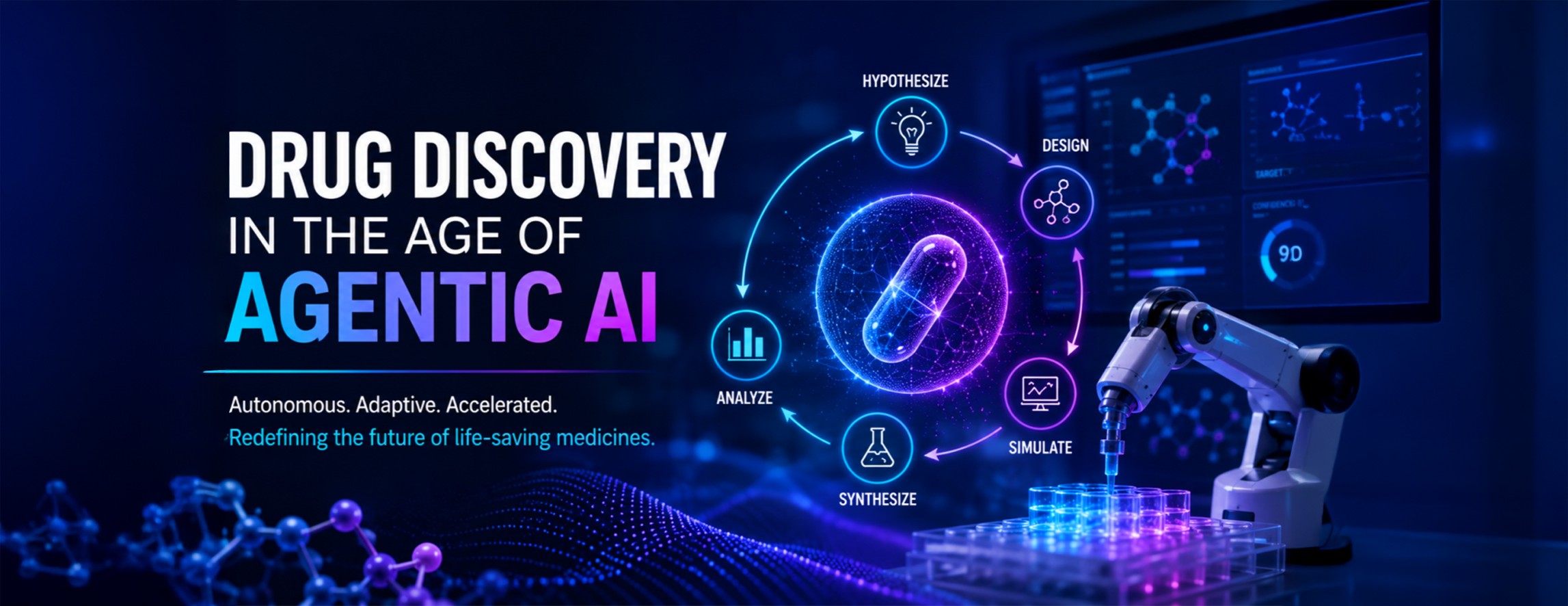
Everyone’s talking about “AI in drug discovery.” But what does an agent actually do that a model doesn’t? And does it really help at the hardest step — hit identification?
“Agentic AI doesn’t replace docking. It wraps it.” ← my favorite — it’s the actual thesis, compact, and immediately curious → “The model isn’t the agent. The loop is.” → “Why ‘AI in drug discovery’ and ‘agentic AI in drug discovery’ are not the same sentence” → “The most interesting AI in drug discovery isn’t the model. It’s what’s around it.”
Let’s start simple.
What is an agent?
A large language model on its own is a responder. You ask, it answers — once. It can’t run code, can’t call a docking engine, can’t remember what it tried yesterday, can’t course-correct when something fails.
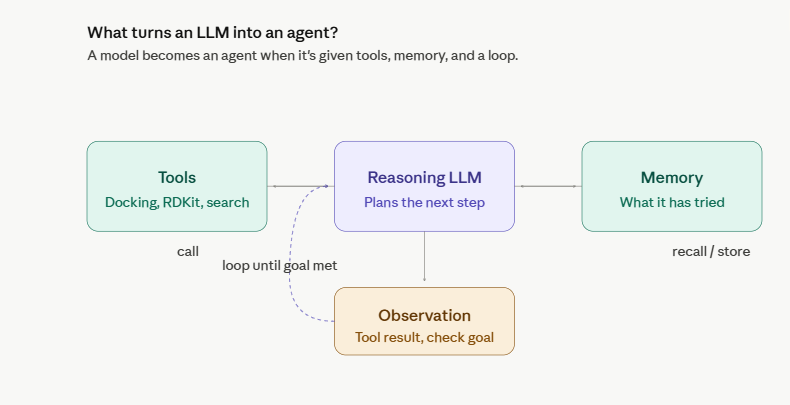
An agent is an LLM placed inside a loop — given tools to call, memory to keep, and the freedom to decide what to do next based on what it just observed. In one sentence: an agent is a model that can act, check, and try again.
So What is “Agentic AI”?
Agentic AI is the broader idea: an AI system that pursues a goal autonomously by chaining together reasoning + tool use + iteration, with limited human prompting at each step. The agent decides which tool to use, when to use it, how to interpret the result, and what to do next. You give it the objective; it works out the path.
This isn’t theoretical anymore. Three landmark papers in the last two years made this concrete for chemistry and drug discovery:
- → ChemCrow (Bran et al., Nat. Mach. Intell. 2024) — a GPT-4 agent equipped with 18 chemistry tools (RXN planner, SMILES validator, safety checker, literature search). It autonomously planned and executed syntheses of an insect repellent and three organocatalysts on a robotic platform.
- → Coscientist (Boiko et al., Nature 2023) — a GPT-4-driven agent that designed, planned, and ran palladium-catalysed cross-coupling reactions end-to-end on a cloud lab, from a single English prompt.
- → PharmAgents (Gao et al., arXiv 2025) — a multi-agent system simulating a full virtual pharma: target ID → screening → lead optimisation → ADMET. Each stage is a specialised agent with its own toolset, coordinated by a planner.
Learn More About – Drug Discovery Services At PI Health Sciences
Hit identification — the traditional way
Now let’s zoom in on the step every campaign starts with: finding active compounds. The classic structure-based workflow is well-defined and good, but it’s manually orchestrated end-to-end. A computational chemist sets parameters, runs each tool, inspects the output, decides what to do next.
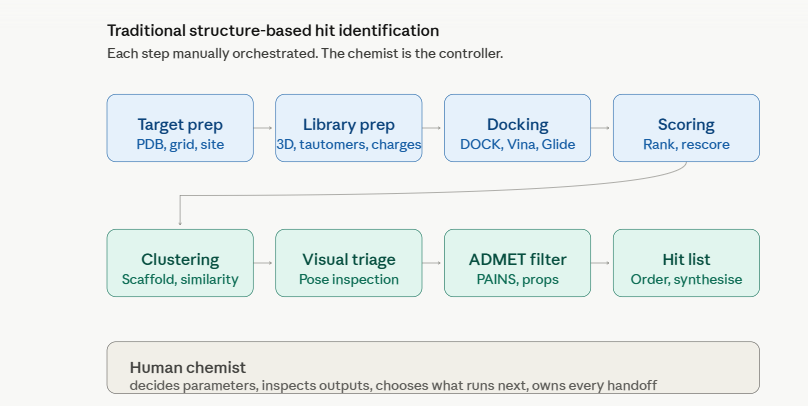
This pipeline is robust, well-validated, and has delivered hits for decades. But notice what’s expensive in time: the chemist is the message bus. Every handoff between tools needs human interpretation. Every “should we re-dock with a different scoring function?” is a decision that has to be made by someone, then queued, then run.
→ “Is your hit-ID workflow about to have a new boss?” → “What happens when the chemist stops orchestrating?” → “Can an AI decide which hits matter?” → “Hit identification, but who’s in the driver’s seat?”
Hit identification — the agentic way
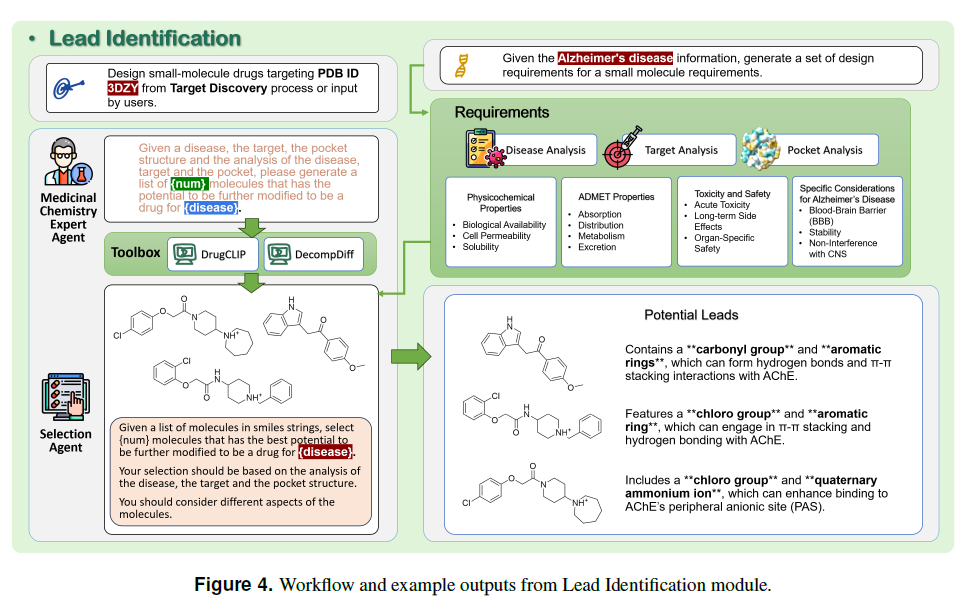
Now imagine the same workflow with an agent in the controller seat. The chemist defines the goal — “find ten hits for target X with novel scaffolds, MW < 450, no PAINS, predicted Ki < 1 µM” — and the agent runs the loop.
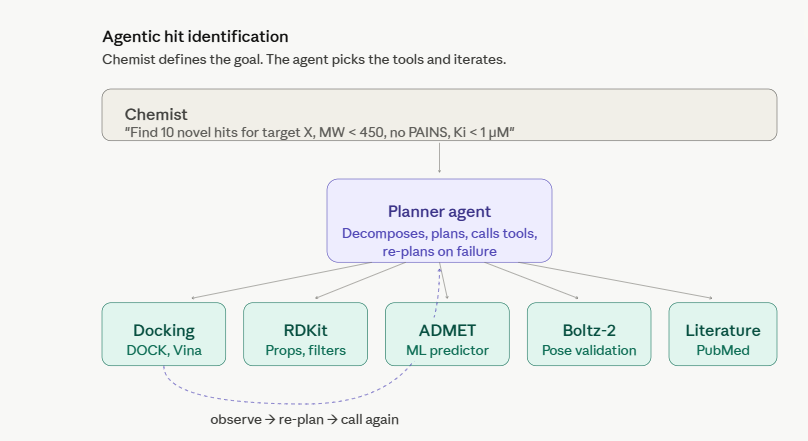
The agent doesn’t replace the physics — it orchestrates it. Docking, RDKit, ADMET, and pose validation still run exactly as they always did. What changes is who calls them, in what order, and how the system reacts when something looks off.
A concrete example: the agent docks a library, sees that the top-50 are full of PAINS, calls RDKit to filter, re-ranks, notices the new top-10 has poor diversity, calls a clustering tool, picks scaffold representatives, runs Boltz-2 to validate poses, flags two with implausible geometry, drops them, queries the literature for known binders to the same site, finds a paper with a chemotype not in the library, suggests an analoging round. All without being told step-by-step.
For example:
So — does it actually help?
The honest answer in May 2026: it helps, but with caveats the field is still learning to manage.
- → Speed-to-decision improves dramatically. Boiko et al. report Coscientist running ~1000 reactions in a weekend after their initial Nature paper — orders of magnitude beyond manual orchestration. (Boiko et al., Nature 624:570, 2023; Chemistry World follow-up.)
- → Domain knowledge gaps are the main failure mode. Liu et al. found that general-purpose LLM agents confidently propose plausible-sounding but domain-wrong implementations — using the wrong featurisation, misinterpreting an assay column, picking an inappropriate baseline. Their DrugAgent framework adds an “Instructor” agent specifically to inject domain knowledge at planning time, and improved ROC-AUC by ~5% over generic ReAct agents on drug-target interaction tasks. (Liu et al., arXiv 2411.15692, 2024.)
- → Multi-agent beats single-agent for complex pipelines. PharmAgents (Gao et al.) and DrugAgent (Inaba et al., ICLR 2025) both show that specialising agents — one for knowledge-graph queries, one for ML prediction, one for literature, one for coordination — gives more consistent results than a single monolithic agent trying to do everything.
- → Governance still matters. Recent work like Mozi (2026) introduces explicit “control planes” and human-in-the-loop checkpoints at high-uncertainty decision boundaries, because fully autonomous agents accumulate small errors over long-horizon pipelines.
If you’re starting your agentic AI learning journey today — here’s the path I’d take
A common question I get: “Where do I actually start with agentic AI?” It’s easy to drown in tutorials. Here’s the pathway I’d follow if I were starting fresh today, ordered by what actually compounds.
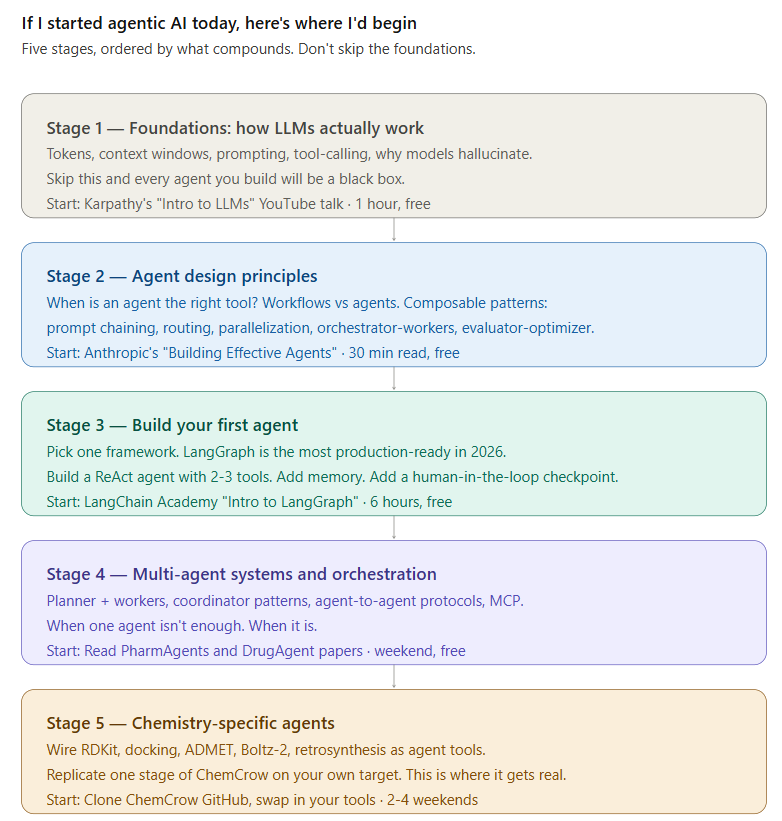
Three honest notes on this path:
- → Don’t skip Stage 1. The single biggest source of “my agent is acting weirdly” is misunderstanding context windows, token budgets, and how tool-calling actually works under the hood. An hour of Karpathy saves a month of debugging.
- → Don’t start with a framework. Anthropic’s own engineering team flags this in Building Effective Agents: many patterns are “a few lines of code” against the raw LLM API. Reach for LangGraph when you need durable execution, persistence, and human-in-the-loop — not before.
- → Stage 5 is where computational chemists have an unfair advantage. Generalist ML engineers can build agents. You already know which tools matter, what good output looks like, and where the failure modes are buried. That domain knowledge is the moat — agents amplify it, not replace it
The takeaway
Agentic AI doesn’t replace physics-based hit identification. It wraps it — adding planning, memory, and iteration to a stack that previously needed a human to glue every step together. The result is faster cycles, more thorough exploration, and the unsettling but useful experience of an AI saying “I tried that, it didn’t work, here’s what I’m doing instead.”
The next frontier isn’t whether agents can find hits. It’s whether we trust them to decide which hits matter.
What’s your take — are agents in your discovery stack yet, or still on the watch-list?
Article Source: https://www.linkedin.com/pulse/agentic-ai-drug-discovery-hype-future-smarter-molecules-bvs-gieyc/
Author BIO

Dr Suneel Kumar BVS
Head of Computational Sciences (Drug Design & AI) | PI Health Sciences
Suneel has 20+ years of experience in Computational Chemistry & AI. In his last assignment, he was working with Molecular Forecaster, Canada as Director, AI & Technology. Previously he has worked with PharmaCADD – South Korea, Sai Life Sciences, Aragen and Curia. Suneel has completed his PhD. in Computational Chemistry from Jawaharlal Nehru Technology University, Hyderabad.
