Protac
Advancing Targeted Protein Degradation from Design to Preclinical Readiness
At PI Health Sciences, our protein degrader platform delivers integrated protac services designed to advance complex protein degradation programs from early hypothesis to preclinical readiness. We enable rational design, validation, and optimization of targeted protein degraders through a unified framework that combines computational intelligence, medicinal chemistry, biology, and DMPK.
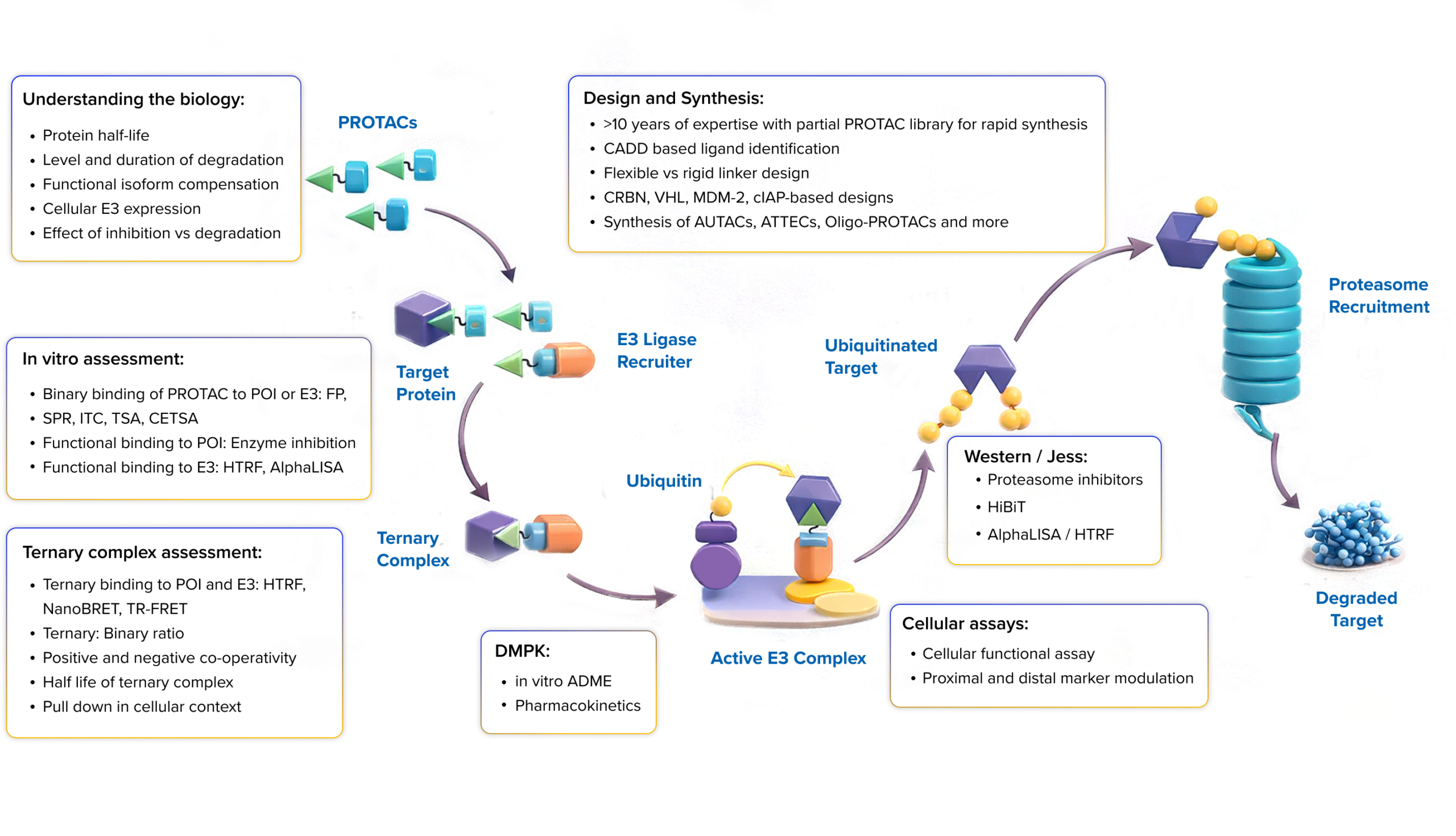
Our protac services address the unique scientific and translational challenges of heterobifunctional degraders, including ternary complex formation, cooperativity, cellular permeability, and exposure-degradation balance. By integrating modelling, synthesis, mechanistic biology, and pharmacokinetics, we ensure degradation efficacy and developability are evaluated together, not sequentially. Supporting Protacs and adjacent targeted degradation approaches across oncology and beyond, our teams operate within a decision-driven development model. Programs are designed with translational relevance, scalability, and downstream regulatory expectations in mind, enabling confident progression toward IND-enabling studies.
Our Capabilities
 01
01
Computational Modelling and Structural Intelligence
Our integrated modelling platform combines structural bioinformatics, AI, and physics-based simulations to design and optimize PROTAC ternary complexes with high confidence.
Key capabilities:- Curated PROTAC knowledgebase for rapid exploration by target, ligase, and linker
- Target–E3 structural preparation and hotspot mapping
- AI-driven pocket prediction and ternary complex docking
- Traditional and generative AI-based linker enumeration
- Molecular dynamics and free-energy scoring to prioritize stable complexes
 02
02
AI-Augmented Design and Optimization
We apply machine learning and explainable AI trained on large PROTAC atasets to guide rational design and compound prioritization.
Core strengths:- GNN and transformer models to predict degradation efficiency and properties
- AI-guided optimization of permeability, solubility, and E3 selectivity
- Explainable insights highlighting key drivers of cooperativity
- Smart decision engine integrating modelling, AI, and experimental data
 03
03
Medicinal Chemistry and Synthesis
Our medicinal chemistry team translates computational insights into synthetically feasible, high-quality PROTAC molecules.
What we deliver:- Rapid synthesis of bifunctional PROTACs
- Broad E3 ligase binders, linker libraries, and warhead options
- Iterative DMTA cycles with SAR-driven optimization
- Physicochemical tuning for permeability and bioavailability
 04
04
In Vitro Biology and Mechanistic Evaluation
We validate PROTAC activity and mechanism using advanced cellular and biochemical assays.
Evaluation includes:- Target and ligase engagement assays
- Ternary complex formation and cooperativity profiling
- Quantitative degradation metrics (DC50, Dmax, kinetics)
- Functional and mechanistic validation of degradation pathways
 05
05
DMPK and Pharmacokinetic Evaluation
Early ADME and DMPK profiling ensures developability and informed progression to in vivo studies.
Services cover:- Permeability, efflux, and metabolic stability assessments
- Solubility, lipophilicity, and metabolite identification
- PK studies and PBPK modelling for exposure prediction
- Early identification of developability liabilities
 06
06
End-to-End Integrated Workflow Visual
Our tightly integrated AI–modelling–chemistry–biology–DMPK workflow enables rapid, feedback-driven PROTAC optimization from design to validation.
Workflow overview:- Target and ligase characterization
- AI-guided PROTAC design
- Synthesis and in vitro screening
- Degradation and PK validation
- Iterative optimization with explainable insights
Frequently asked questions
We’re here to help with any questions you have about our plans, supported features, and how our model works.
How does PI Health Sciences approach integrated protein degrader discovery?
PI Health Sciences executes protein degrader programs as unified workflows where modelling, synthesis, biology, and DMPK inform each other continuously. Computational insights guide chemistry, biological data refines design hypotheses, and pharmacokinetics shapes translational decision-making, resulting in coherent, decision-ready datasets.
What differentiates PI Health Sciences’ PROTAC services from conventional approaches?
Our protac discovery services focus on ternary complex cooperativity, cellular degradation kinetics, and exposure alignment from the outset. This integrated approach minimizes false positives driven by binding alone and prioritizes degraders with true translational potential.
How are degradation efficacy and developability balanced during optimization?
Design decisions are guided by simultaneous evaluation of degradation potency, permeability, metabolic stability, and PK behavior. This prevents over-optimization of degradation at the expense of in vivo exposure or formulation feasibility.
Can PI Health Sciences support emerging targeted degradation strategies beyond classical PROTACs?
Yes. In addition to heterobifunctional degraders, we support molecular glues and select New Modalities, applying the same integration principles of modelling, chemistry, biology, and translational assessment.
Contact Us
Connect with PI Health Sciences to explore how our PROTAC approach enables ubiquitin-proteasome-mediated degradation of disease-relevant proteins, spanning ligand discovery through translational preclinical evaluation.