
TPD Modalities

Integrated Services for Emerging Targeted Protein Degradation Technologies
At PI Health Sciences, our Other Targeted Protein Degradation Platform is built to push beyond classical proteasome-centric strategies and unlock access to challenging, previously undruggable targets. The platform is engineered to support a broad spectrum of TPD modalities that engage proteasomal, autophagy, lysosome, and lysosomal trafficking pathways, allowing programs to be designed around real target biology rather than forced chemistry.
TPD Modalities
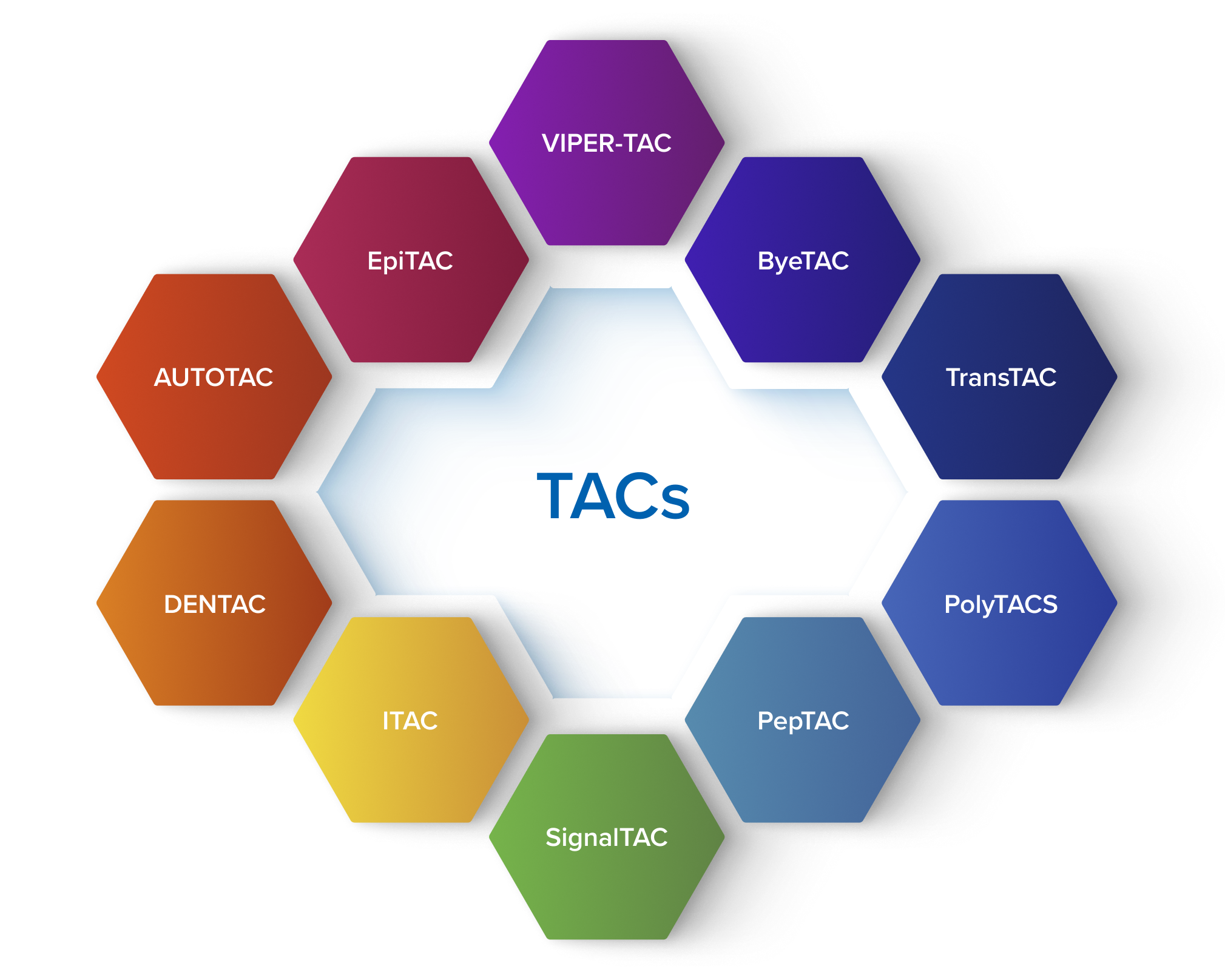
In addition to PROTAC, LYTAC, AUTAC, ATTEC, AbTAC, and related approaches, we enable emerging degradation strategies that leverage autophagy lysosome systems, receptor mediated endocytosis, and antibody driven internalization. These pathways allow precise intervention across intracellular aggregates, membrane associated proteins, and extracellular disease drivers where conventional degradation mechanisms fall short.
Our integrated framework enables rational modality selection based on subcellular localization, disease mechanism, exposure requirements, and translational feasibility. These capabilities complement established PROTAC and molecular glue programs by enabling targeted protein degradation through orthogonal mechanisms tailored to complex biological contexts.
By tightly integrating chemistry, cell biology, pharmacology, and translational modeling, we support TPD programs from hit identification through preclinical candidate selection across diverse degradation modalities. Our execution model ensures that degradation mechanisms, biological relevance, safety considerations, and exposure requirements are evaluated together, enabling early risk reduction and smarter decision making for high complexity targets.
TPD Modality Comparison
| Modality | Pathway | Target Scope | Key Advantage |
|---|---|---|---|
| AUTAC | S-guanylation → K63-Ub → Autophagy | Aggregates, organelles | Mitophagy, large substrates |
| AUTOTAC | p62 activation → Autophagy | Aggregates, oncoproteins | Sequestration, clinical validation |
| ATTEC | LC3 tethering → Autophagy | Proteins, lipid droplets | BBB penetration, Ub-independent |
| AbTAC | RNF43/ZNRF3 → Lysosome | Membrane proteins | Fully recombinant, GPCRs/RTKs |
Emerging Modalities: Next-Generation Technologies
The TPD field continues to expand with innovative approaches addressing specific challenges and therapeutic needs.
| Technology | Applications |
|---|---|
| GlueTAC | Covalent nanobody-based degrader with lysosome-sorting sequence. Targets cell-surface proteins (PD-L1) with superior efficacy vs. antibody inhibitors. Combines cell-penetrating peptides with LSS motifs. |
| HyT (Hydrophobic Tag) | Hydrophobic moiety induces protein misfolding and aggregation for proteasomal degradation. Simpler design than bifunctional PROTACs. Targets include BRD4, FKBP12. |
| SNIPER | Specific and nongenetic IAP-dependent protein eraser. Recruits IAP E3 ligases (cIAP1, XIAP) for degradation. Pioneering work in E3 ligase diversity for TPD. |
| TRIM-Away | Antibody-TRIM21 system for rapid protein knockdown. TRIM21 recognizes antibody Fc region for proteasomal degradation. Applications in functional genomics and target validation. |
| KineTAC | Cytokine receptor-targeting chimera for cell-specific degradation. Harnesses cytokine receptor internalization for targeted delivery. Enables tissue-selective TPD. |
| PhotoPROTAC | Light-activated PROTAC for spatiotemporal control. Photoswitch or photocage enables on-demand activation. Applications in precise biological studies. |
| Bispecific Aptamer Chimera | DNA/RNA aptamers link membrane proteins to lysosomal receptors. Oligonucleotide-based alternative to antibodies. Targets extracellular and membrane proteins. |
| CMA-Based Degraders | Chaperone-mediated autophagy targeting. KFERQ-like motif recognition by HSC70. Selective for misfolded or pathogenic proteins. |
Our Capabilities in TPD Modalities
 01
01
Multi-Modal Autophagy and Lysosomal Degradation Expertise
Integrated capabilities across AUTAC, AUTOTAC, ATTEC, and antibody-based lysosomal degradation enable targeted removal of aggregates, membrane proteins, organelles, and UPS-resistant targets across therapeutic areas.
 02
02
Modality-Agnostic Target and Pathway Selection
Objective, biology-driven selection of degradation mechanisms ensures optimal use of TPD Modalities based on target localization, disease context, and translational feasibility rather than platform bias.
 03
03
CNS, Aggregate, and Membrane Protein Coverage
Specialized strategies support challenging target classes including CNS-relevant proteins, pathological aggregates, GPCRs, RTKs, and immune checkpoints that are not addressable by proteasome-limited approaches.
 04
04
Integrated Discovery to Preclinical Execution
Seamless progression from target validation and degrader design to in vivo proof of mechanism, PK PD correlation, and candidate readiness under a single scientific framework.
 05
05
Mechanistic and Translational Rigor
Deep MOA validation through autophagy flux, degradation kinetics, biomarker alignment, and disease-relevant in vivo models ensures degradation is causal, durable, and decision-enabling.
 06
06
Progression-Focused Development Model
Programs are designed to generate regulator- and investor-ready datasets that support confident advancement, even where other TPD (Targeted Protein Degradation) platforms offer services limited to exploratory validation.
Frequently asked questions
We’re here to help with any questions you have about our plans, supported features, and how our model works.
How does PI Health Sciences support multiple TPD modalities within a single program?
Programs are designed with parallel evaluation of degradation pathways, allowing rapid comparison of autophagy-, lysosome-, and proteasome-driven strategies. This enables informed modality selection and minimizes late-stage rework.
Can PI Health Sciences integrate emerging modalities with established PROTAC programs?
Yes. Our platform is designed to integrate PROTAC, AUTAC, ATTEC, LYTAC, and antibody-based degraders within a unified development strategy, ensuring continuity of data and regulatory narratives.
How is translational relevance ensured for non-classical degradation pathways?
We combine cellular degradation kinetics, biomarker linkage, and in vivo proof-of-mechanism studies to establish exposure–degradation–response relationships that support confident preclinical decisions.
What stage of development does the platform support?
Our TPD Modalities Research and development capabilities span hit identification, lead optimization, in vivo validation, and preclinical candidate enablement for programs pursuing targeted protein degradation (TPD) beyond conventional approaches.
Contact Us
Connect with PI Health Sciences to explore how our TPD platform approaches enable selective degradation of disease-relevant proteins, spanning molecular design to translational preclinical advancement.